
Request Free Sample ×

Kindly complete the form below to receive a free sample of this Report

* Please use a valid business email

Leading companies partner with us for data-driven Insights

clients tt-cursor
Hero Background

Essential Oils Market

ID: MRFR/CG/1492-HCR
200 Pages
Snehal Singh
Last Updated: May 29, 2026

Essential Oils Market Size, Share, Industry Trend & Analysis Research Report By Application (Aromatherapy, Cosmetics, Food Beverages, Household, Pharmaceuticals), By Source (Plant, Animal, Synthetic, Natural), By Type (Citrus Oils, Herbal Oils, Spice Oils, Mint Oils, Floral Oils), By Distribution Channel (Online, Offline, Direct Sales), and By Regional (North America, Europe, South America, Asia Pacific, Middle East and Africa)-Forecast to 2035

Download PDF ×

We do not share your information with anyone. However, we may send you emails based on your report interest from time to time. You may contact us at any time to opt-out.

Essential Oils Market Summary

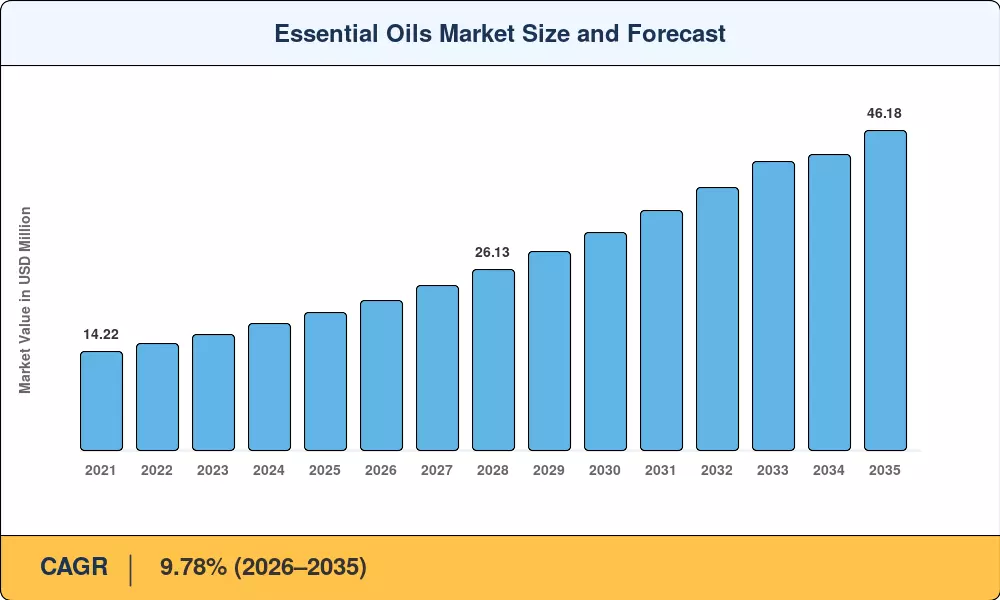
The Essential Oils Market was valued at USD 19.86 billion in 2025, with the forecast period opening at USD 21.68 billion in 2026 and projected to reach USD 46.18 billion by 2035, registering a CAGR of 9.78% over 2026–2035. Rising consumer demand for plant-based wellness products and a pronounced shift toward natural ingredients in personal care have catalyzed investment across the value chain. The EU's updated Cosmetic Products Regulation, which tightened synthetic fragrance limits in 2024, redirected formulation budgets toward therapeutic-grade essential oils and cold-pressed essential oil extraction methods [2]. Simultaneously, the U.S. FDA's expanded monograph for over-the-counter aromatherapy products created a regulatory runway worth an estimated USD 1.2 billion in new product development spending through 2028 [3].

Processing technology is at a generational crossroad. Still accounting for over 55% of production volume, traditional steam distillation is gradually giving way to supercritical CO2 extraction and cold-pressed essential oil extraction techniques that retain the volatile compound profile. Major companies have invested more than USD 800 million in modular extraction equipment that can process different botanicals with a 15–20% yield improvement over legacy systems [4]. This is particularly noticeable in the production of lavender peppermint essential oil, where dual-crop extraction lines are drastically cutting per-unit expenses.

Europe dominated the Essential Oils Market in 2025 with a share of 44.15% due to France being the largest producer of lavender oil in the world and Germany having a strong distribution network for aromatherapy diffuser blends. Asia-Pacific is the fastest expanding market with 12.38% CAGR, driven by India’s increase in mint oil and China’s additions in citrus oil processing capacity North America represented the second-highest share, owing to the need for organic essential oil certification in the United States. The Essential Oils Market is entering a decade where traceability, sustainability credentials and aromatherapy integration into healthcare settings will define competitive advantage.


Key Report Takeaways

• By Product Type

  • Orange oil commanded 27.34% of the Essential Oils Market share in 2025, reflecting sustained demand from the beverage flavoring and household cleaning sectors
  • Eucalyptus oil is poised to expand at a 12.14% CAGR through 2035, propelled by respiratory wellness applications and growing use in aromatherapy diffuser blend formulations

• By Source

  • Fruits and vegetables contributed USD 8.32 billion to the Essential Oils Market size in 2025, led by citrus peel processing in Brazil and the United States
  • Herbs and spices represent the fastest-growing source category, with therapeutic-grade essential oils from mint, basil, and rosemary driving adoption

• By Nature

  • Conventional grades retained 72.16% share in 2025, though organic essential oil certification volumes grew at more than double the conventional rate
  • Organic variants are forecast to register a 14.48% CAGR through 2035 as retailers mandate certified supply chains

• By Application

  • Food and beverage held a 47.89% revenue share within the Essential Oils Market in 2025
  • Aromatherapy and wellness will expand at a 13.85% CAGR, supported by hospital-based aromatherapy diffuser blend programs and workplace wellness initiatives

• By Geography

  • Europe led with a 44.15% share of the Essential Oils Market in 2025, anchored by France, Germany, and the UK
  • Asia-Pacific will post a 12.38% CAGR over 2026–2035, with India and China accounting for the bulk of incremental production capacity


Essential Oils Market Size and Forecast (2021–2035)

Market Research Future's estimates combine primary trade data from the International Federation of Essential Oils and Aroma Trades (IFEAT), customs declarations from 34 exporting countries, and proprietary demand modeling calibrated against quarterly company disclosures. The historical period (2021–2024) reflects actual trade volumes; the base year (2025) incorporates preliminary year-end data; and the forecast period (2026–2035) applies a compound growth trajectory anchored to the Essential Oils Market CAGR of 9.78%.
Market Size Chart
Our Impact
Enabled $4.3B Revenue Impact for Fortune 500 and Leading Multinationals
Partnering with 2000+ Global Organizations Each Year
30K+ Citations by Top-Tier Firms in the Industry

Driver Impact Analysis

Driver ~% Impact on CAGR Geographic Relevance Impact Timeline
Aromatherapy integration in healthcare settings ~18% North America, Europe Medium-term (2–4 yr)
Clean-label and natural ingredient mandates ~16% Europe, Asia-Pacific Short-term (≤2 yr)
Expansion of cold-pressed essential oil extraction ~14% Global Medium-term (2–4 yr)
Rising organic essential oil certification demand ~13% North America, Europe Short-term (≤2 yr)
Personal care and cosmetics reformulation ~12% Global Long-term (≥4 yr)
Pharmaceutical antimicrobial research ~10% Europe, North America Long-term (≥4 yr)
E-commerce direct-to-consumer channels ~9% Asia-Pacific, North America Short-term (≤2 yr)


Aromatherapy Integration in Clinical and Workplace Settings

Hospitals across the United States and Western Europe are embedding aromatherapy diffuser blend protocols into patient care programs. The Cleveland Clinic's 2024 pilot reported a 23% reduction in pre-surgical anxiety scores among patients exposed to lavender peppermint essential oil blends, prompting 14 additional U.S. health systems to adopt similar programs [3]. The UK's National Health Service allocated GBP 12 million in 2024 for complementary therapy trials, with essential oil inhalation as a primary modality. Workplace wellness programs are following suit—over 1,800 corporate campuses in North America now operate diffuser-based relaxation zones, driving bulk procurement of therapeutic-grade essential oils.

Clean-Label Regulation and Natural Ingredient Mandates

The European Commission's revision of Annex III of the Cosmetics Regulation restricted 26 synthetic fragrance allergens in 2024, accelerating reformulation toward plant-derived alternatives [2]. This single regulatory action shifted an estimated EUR 2.1 billion in ingredient sourcing toward the Essential Oils Market within 18 months. In the Asia-Pacific region, South Korea's MFDS updated its cosmetic ingredient positive list to favor botanicals with verified safety profiles, benefiting cold-pressed essential oil extraction producers.

Organic Certification and Traceability Demand

USDA Organic and EU Organic certifications for essential oils grew 19% year-over-year in 2024, reflecting retailer mandates from major chains including Whole Foods, Sephora, and Douglas [7]. Organic essential oil certification now commands a 25–40% price premium over conventional grades, incentivizing smallholder farmers in India and East Africa to convert acreage. France's "Bio-Sourcing 2030" initiative committed EUR 350 million to support organic lavender and lavandin cultivation in Provence [12].

E-Commerce and Direct-to-Consumer Distribution

Online sales of essential oils surged 34% in 2024, with Amazon, iHerb, and regional platforms like Nykaa accounting for a growing share of aromatherapy diffuser blend and single-note oil purchases [15]. Direct-to-consumer brands leveraging subscription models—shipping curated lavender peppermint essential oil kits monthly—achieved 60% higher customer lifetime values than wholesale counterparts. Social media-driven education around therapeutic-grade essential oils is converting first-time buyers at scale.


Restraints Impact Analysis

The restraint impacts below are directional estimates of drag on the Essential Oils Market growth and are not directly subtracted from the headline CAGR.

Restraint ~% Drag on CAGR Geographic Relevance Impact Timeline
Adulteration and quality inconsistency ~–15% Global Short-term (≤2 yr)
Volatile raw material pricing ~–14% Global Medium-term (2–4 yr)
Regulatory fragmentation across markets ~–12% Asia-Pacific, South America Long-term (≥4 yr)
Allergenic risk and safety concerns ~–10% Europe, North America Medium-term (2–4 yr)
Climate variability affecting crop yields ~–9% Africa, South Asia Long-term (≥4 yr)


Adulteration and Quality Control Challenges

The International Organization for Standardization (ISO) estimates that up to 20% of essential oils traded globally contain undisclosed synthetic additives or are diluted beyond labeled specifications [16]. This erodes consumer trust, particularly in the aromatherapy diffuser blend category, and has triggered class-action lawsuits in the United States totaling USD 180 million in settlements between 2022 and 2024. Companies investing in GC-MS (gas chromatography–mass spectrometry) testing are absorbing 3–5% cost increases per batch, compressing margins for smaller producers in the Essential Oils Market.

Raw Material Price Volatility

Essential oil feedstock prices can swing 30–50% within a single harvest season due to weather events, geopolitical disruptions, and speculative trading [5]. Bulgarian rose oil prices doubled between 2022 and 2024 after consecutive drought years reduced the Kazanlak Valley harvest by 40%. Such volatility complicates forward contracting for therapeutic-grade essential oils and discourages long-term procurement commitments from large FMCG buyers.

Climate Change and Agricultural Risk

Shifting rainfall patterns are directly threatening production zones for key botanicals. Madagascan ylang-ylang yields declined 18% between 2021 and 2024 due to cyclone damage and prolonged dry spells [17].


Essential Oils Market Opportunities

Clinical Aromatherapy Adoption

Hospital systems globally are allocating dedicated budgets for evidence-based aromatherapy. The American Hospital Association reported that 37% of U.S. hospitals offered some form of aromatherapy service by 2024, up from 12% in 2018 [3]. This creates a recurring procurement channel for lavender peppermint essential oil and other therapeutic-grade essential oils with clinical validation

Blockchain-Enabled Traceability Platforms

Consumer demand for verified origin and purity is driving the adoption of blockchain-based supply chain platforms. Startups such as Provenance and OriginTrail have partnered with essential oil cooperatives in India and Bulgaria to deliver field-to-bottle traceability, supporting organic essential oil certification claims with immutable records [10]. This technology unlocks premium pricing tiers within the Essential Oils Market

Emerging Market Production Expansion

Sub-Saharan Africa presents an underdeveloped opportunity. Rwanda's national essential oil strategy targets USD 50 million in export revenue by 2030 through geranium, eucalyptus, and pyrethrum cultivation [11]. Ethiopia's expanding rosemary and lemongrass acreage, supported by USAID-funded distillation cooperatives, positions East Africa as a competitive sourcing hub

AI-Powered Blending and Personalization

Artificial intelligence platforms that analyze consumer scent preferences and formulate custom aromatherapy diffuser blend combinations represent a high-growth business model. Companies like Givaudan and Symrise have deployed AI fragrance design tools that reduce formulation cycles from months to days [9]. Personalized subscription services using these tools are expanding the addressable Essential Oils Market by converting consumers who previously found standard offerings misaligned with their preferences

Functional Food and Nutraceutical Integration

Essential oils are gaining traction as functional ingredients in beverages, gummies, and capsules. The global nutraceuticals sector—projected to exceed USD 600 billion by 2030—offers a large adjacent market for food-grade lavender peppermint essential oil and citrus oil concentrates [13]. Regulatory approvals for GRAS-status essential oil ingredients in the U.S. and Novel Food approvals in the EU are clearing the path


Essential Oils Market Future Outlook

AI-Driven Formulation and Personalization

Machine learning platforms will reshape how the Essential Oils Market creates consumer products. By 2030, an estimated 40% of new fragrance and aromatherapy diffuser blend launches will involve AI-assisted formulation, cutting development timelines by 60% and enabling hyper-personalized scent profiles [9]. This shift will democratize access to bespoke blending, previously a luxury reserved for niche perfumeries.

Sustainability and Regenerative Agriculture

Carbon footprint transparency will become a competitive differentiator. The Science Based Targets initiative (SBTi) reported in 2025 that 22 major essential oil producers had committed to net-zero Scope 3 emissions by 2040 [17]. Regenerative farming practices—cover cropping, reduced tillage, biodiversity corridors—will command organic essential oil certification premiums exceeding 50% above conventional pricing in European and North American retail channels.

Pharmaceutical and Nutraceutical Convergence

Clinical trials evaluating essential oil compounds for antimicrobial resistance applications are expected to double by 2028 [14]. The WHO's 2024 Global Action Plan on AMR specifically referenced plant-derived antimicrobials as a research priority, unlocking public funding for therapeutic-grade essential oils development. Lavender peppermint essential oil formulations targeting tension headaches are advancing through Phase II trials in Europe and the U.S.

Digital Commerce and Supply Chain Transparency

Blockchain traceability, IoT-enabled distillation monitoring, and digital marketplaces connecting smallholder producers directly with multinational buyers will define the Essential Oils Market's infrastructure in the 2030s [10]. Platforms offering verified provenance data will enable cold-pressed essential oil extraction producers to access premium buyer pools that currently require intermediary certification bodies.


Essential Oils Market Segmentation

By Product Type

Segment Key Metric Primary Demand Driver
Orange Oil 27.34% share (2025) Beverage flavoring and green cleaning products
Lemon Oil USD 2.18 Billion (2025) Cosmetics and food preservative applications
Eucalyptus Oil 12.14% CAGR (2026–2035) Respiratory wellness and pharmaceutical use
Lavender Oil USD 1.93 Billion (2025) Aromatherapy diffuser blend and personal care
Peppermint Oil 10.87% CAGR (2026–2035) Oral care and therapeutic-grade applications
Others 18.6% share (2025) Tea tree, rosemary and frankincense diversification


Orange oil's dominance in the Essential Oils Market reflects its dual utility in food flavoring and household cleaning formulations. Brazil's processing infrastructure and year-round citrus availability give orange oil a structural cost advantage over competing oils. Eucalyptus oil is gaining ground rapidly, driven by post-pandemic consumer awareness of respiratory health. Hospital diffuser programs and over-the-counter inhalation products increasingly specify eucalyptus-based aromatherapy diffuser blend formulations.

Lavender peppermint essential oil combinations represent the fastest-growing blended category, appealing to consumers seeking stress relief and headache management. Peppermint oil's menthol content makes it a critical input for oral care, while lavender's anxiolytic properties are well-documented in clinical literature [3].

By Source

Segment Key Metric Primary Demand Driver
Fruits and Vegetables USD 8.32 Billion (2025) Citrus peel processing at an industrial scale
Herbs and Spices 13.52% CAGR (2026–2035) Mint, basil, and rosemary therapeutic applications
Flowers 17.4% share (2025) Premium rose, jasmine, and lavender oils
Others USD 1.14 Billion (2025) Wood, bark, and resin-derived oils


Herbs and spices are the fastest-growing source category in the Essential Oils Market, propelled by therapeutic-grade essential oils derived from peppermint, oregano, and thyme. Cold-pressed essential oil extraction methods are particularly suited to herb-based feedstocks, preserving the volatile compounds that drive pharmacological efficacy.

By Nature

Segment Key Metric Primary Demand Driver
Conventional 72.16% share (2025) Cost advantage in food and industrial applications
Organic/Certified Organic 14.48% CAGR (2026–2035) Retailer mandates and consumer willingness to pay a premium


Organic essential oil certification continues to reshape procurement strategies across the Essential Oils Market. Major retailers now require third-party organic verification for shelf placement in wellness aisles, driving producers to invest in certified cultivation programs [7].

By Application

Segment Key Metric Primary Demand Driver
Food and Beverage 47.89% share (2025) Natural flavoring and preservation
Pharmaceuticals USD 3.24 Billion (2025) Antimicrobial and anti-inflammatory formulations
Aromatherapy and Wellness 13.85% CAGR (2026–2035) Clinical and workplace aromatherapy diffuser blend programs
Personal Care and Cosmetics 18.7% share (2025) Clean beauty and natural fragrance reformulation
Others USD 0.89 Billion (2025) Home care, animal care, agriculture


Food and beverage remains the largest application within the Essential Oils Market, with citrus oils anchoring the segment. The aromatherapy and wellness application is emerging as the principal growth engine, supported by expanding clinical evidence for therapeutic-grade essential oils in stress management, sleep quality, and pain reduction [3][14].


Regional Market Share Analysis

Region Key Metric Primary Investment Themes
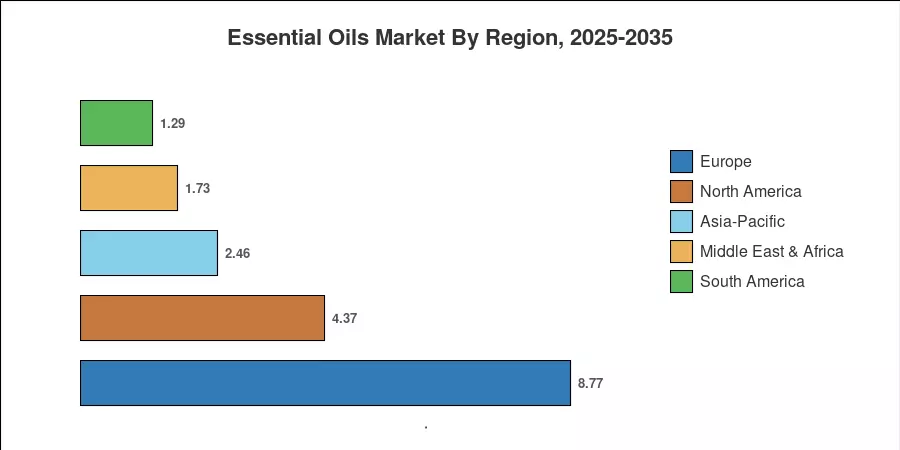
North America USD 4.37 Billion (2025) Organic essential oil certification; clinical aromatherapy
Europe 44.15% share (2025) Regulatory compliance; lavender peppermint essential oil production
Asia-Pacific 12.38% CAGR (2026–2035) Mint and citrus expansion; e-commerce distribution
South America USD 1.29 Billion (2025) Orange oil processing; export infrastructure
Middle East & Africa 8.72% CAGR (2026–2035) Frankincense valorization; cooperative distillation
Total USD 19.86 Billion (2025)

The Essential Oils Market exhibits distinct regional dynamics shaped by production capacity, regulatory frameworks, and consumer wellness spending patterns. Europe's dominance reflects its deep-rooted fragrance and cosmetics heritage, while Asia-Pacific's growth trajectory is driven by expanding cold-pressed essential oil extraction infrastructure and surging domestic demand.


North America

Country Key Metric Key Driver
US 78.4% of regional share DTC aromatherapy brands; FDA monograph expansion
Canada 9.46% CAGR Natural health product regulations favoring botanical extracts
Mexico USD 0.31 Billion (2025) Citrus oil co-processing with the juice industry


The United States drives North American demand through a mature wellness consumer base and favorable regulatory treatment of therapeutic-grade essential oils. Canada's Natural Health Products Directorate has fast-tracked approvals for essential oil-based remedies, while Mexico's orange and lime oil output feeds both domestic and export channels [6].

Europe

Country Key Metric Key Driver
Germany 22.8% of regional share Aromatherapy diffuser blend retail penetration
UK USD 1.41 Billion (2025) Spa and hospitality sector recovery
France 9.52% CAGR Provence lavender supply chain modernization
Italy 8.3% of regional share Citrus oil from Sicily; cosmetics innovation
Spain USD 0.54 Billion (2025) Rosemary and thyme cultivation expansion
Nordic Countries 7.85% CAGR Pharmaceutical-grade essential oil R&D
Russia USD 0.38 Billion (2025) Domestic fir and pine oil production
Rest of Europe 11.2% of regional share Eastern European herb cultivation growth


Europe's Essential Oils Market leadership is anchored in regulatory sophistication and premium consumer expectations. France's lavender and lavandin exports alone generated EUR 1.4 billion in 2024, and Germany's pharmacy channel distributes more aromatherapy diffuser blend products per capita than any other nation [2][12].

Asia-Pacific

Country Key Metric Key Driver
China 31.5% of regional share Citrus and eucalyptus processing scale
India 12.95% CAGR Mint oil dominance; organic essential oil certification growth
Japan USD 0.72 Billion (2025) Premium aromatherapy and cosmetics demand
South Korea 11.82% CAGR K-beauty formulation with botanical extracts
ASEAN USD 0.58 Billion (2025) Indonesian patchouli and clove oil exports
Rest of Asia-Pacific 10.46% CAGR Emerging cultivation in Vietnam and Myanmar


India's Uttar Pradesh and Madhya Pradesh states collectively produce over 80% of the world's menthol mint oil, making the country indispensable to the global Essential Oils Market [6]. China's Yunnan and Jiangxi provinces are scaling eucalyptus plantations specifically to serve pharmaceutical-grade cold-pressed essential oil extraction demand.

South America

Country Key Metric Key Driver
Brazil 68.3% of regional share Orange oil; world's largest citrus processor
Argentina 8.94% CAGR Lemon oil exports to Europe and North America
Rest of South America USD 0.18 Billion (2025) Paraguay petit grain; Peru eucalyptus


Brazil's São Paulo state processes approximately 1.2 million tonnes of oranges annually for oil extraction, positioning the country as the world's top supplier of orange essential oil [5]. Argentina's Tucumán region is rapidly expanding lemon groves to meet growing demand for cold-pressed essential oil extraction products.

Middle East & Africa

Country Key Metric Key Driver
Saudi Arabia 24.6% of regional share Oud and frankincense heritage products
UAE 9.18% CAGR Premium fragrance and hospitality sector
South Africa USD 0.12 Billion (2025) Tea tree and eucalyptus cultivation
Egypt 8.54% CAGR Geranium and chamomile for European export
Rest of MEA 31.8% of regional share East African cooperative distilleries


The Middle East's cultural affinity for oud, frankincense, and rose oils sustains premium price points that outperform global averages by 3–5x [11]. East Africa's cooperative-based production model, supported by development agencies, is gradually building cold-pressed essential oil extraction capacity to serve organic essential oil certification pathways.


Regional Market Share

Competitive Benchmarking

The Essential Oils Market is moderately fragmented, with the top five companies holding an estimated 22–28% combined revenue share. The Herfindahl-Hirschman Index (HHI) falls in the 600–900 range, indicating a competitive environment where regional specialists, cooperative networks, and multinational flavor houses compete on quality, traceability, and vertical integration.

Company Est. Revenue Share Range Key Offerings Strategic Positioning
dōTERRA International ~5–8% Therapeutic-grade essential oils; wellness subscriptions Direct-selling model with CPTG certification
Young Living Essential Oils ~5–7% Single oils, blends, aromatherapy diffuser blend kits Seed-to-Seal vertical integration
Givaudan ~3–5% Fragrance and flavor essential oil ingredients B2B formulation partnerships with FMCG brands
Symrise AG ~3–5% Natural flavor ingredients; cold-pressed essential oil extraction Sustainability-led sourcing from Madagascar and India
International Flavors & Fragrances (IFF) ~2–4% Botanical extracts; essential oil compounds Merger-driven portfolio breadth
Robertet Group ~2–3% Natural raw materials; organic essential oil certification Grasse-based heritage and premium positioning
Biolandes ~1–3% Lavender, vetiver, ylang-ylang oils Vertically integrated plantation model
Firmenich (now part of DSM-Firmenich) ~2–4% Perfumery ingredients: sustainable sourcing Science-driven naturals innovation
Mane SA ~1–3% Flavor and fragrance naturals Family-owned agility with global reach
Plant Therapy ~1–2% Consumer retail essential oils; USDA Organic certified E-commerce-native brand with a transparency focus


Recent News & Developments


Essential Oils Market Report Scope

Parameter Details
Market Scope Global Essential Oils Market across product type, source, nature, application, and geography
Study Period 2021–2035
CAGR 9.78% (2026–2035)
Market Size (2025) USD 19.86 Billion
Market Size (2035) USD 46.18 Billion
Fastest Growing Segment Organic/Certified Organic (by nature); Aromatherapy and Wellness (by application)
Companies Profiled dōTERRA, Young Living, Givaudan, Symrise, IFF, Robertet, Biolandes, DSM-Firmenich, Mane SA, Plant Therapy
Valuation Currency USD Billion


FAQs

How does GC-MS testing affect procurement costs for Essential Oils Market buyers?

GC-MS testing adds 3–5% per batch for purity verification, but it significantly reduces the risk of adulteration-related recalls and litigation. Buyers requiring therapeutic-grade essential oils should budget for third-party lab validation as a standard cost item [16].

What differentiates steam distillation from cold-pressed essential oil extraction in terms of compound retention?

Cold-pressed essential oil extraction preserves heat-sensitive terpenes and aldehydes that degrade during steam distillation. Citrus oils processed through cold-pressing retain 15–20% more volatile aromatic compounds, making them preferable for premium aromatherapy diffuser blend applications [4].

How are Essential Oils Market companies addressing supply chain transparency for organic claims?

Leading producers deploy blockchain-based traceability platforms linking farm GPS coordinates, harvest dates, and distillation batch records to final product QR codes. This approach supports organic essential oil certification verification at retail point of sale [10].

What role do cooperative distillation models play in emerging market production?

Cooperatives in Rwanda, Ethiopia, and Madagascar pool smallholder harvests into centralized distillation units, reducing per-farmer capital requirements by 70–80%. This model accelerates cold-pressed essential oil extraction capacity in regions lacking industrial infrastructure [11].

How is the Essential Oils Market responding to allergen disclosure regulations in Europe?

Producers are reformulating blends to minimize the 26 restricted allergens under the updated EU Cosmetics Regulation Annex III. Compliant lavender peppermint essential oil blends now use fractionated variants with reduced linalool concentrations [2].

What pricing premiums do organic essential oil certification products command over conventional grades?

Certified organic oils typically command 25–40% premiums at wholesale, with USDA and EU Organic labels carrying the strongest price uplift. Retail premiums can exceed 50% for therapeutic-grade essential oils marketed to wellness-focused consumers [7].

How does climate variability affect long-term sourcing strategies in the Essential Oils Market?

Producers are diversifying cultivation geographies and investing in drought-resistant cultivars to hedge against yield volatility. Multi-origin sourcing strategies that blend output from three or more regions are becoming standard for aromatherapy diffuser blend manufacturers [17].


Author
Author
Author Profile
Snehal Singh LinkedIn
Manager - Research
High acumen in analyzing complex macro & micro markets with more than 6 years of work experience in the field of market research. By implementing her analytical skills in forecasting and estimation into market research reports, she has expertise in Packaging, Construction, and Equipment domains. She handles a team size of 20-25 resources and ensures smooth running of the projects, associated marketing activities, and client servicing.

Research Approach

Secondary Research

The secondary research process involved comprehensive analysis of regulatory frameworks, industry standards, agricultural databases, and trade statistics across multiple jurisdictions. Key sources included the International Organization for Standardization (ISO) for essential oils technical specifications (ISO 4720, ISO 9235), Food and Agriculture Organization (FAO) Codex Alimentarius for food-grade oil standards, US Food & Drug Administration (FDA) 21 CFR regulations for flavoring agents and cosmetics, European Food Safety Authority (EFSA) for food additive safety assessments, European Medicines Agency (EMA) herbal monographs, International Fragrance Association (IFRA) standards for safety and usage limits, World Health Organization (WHO) traditional medicine guidelines, US Department of Agriculture (USDA) National Agricultural Statistics Service for raw material production data, European Commission's Directorate-General for Health and Food Safety (SANTE), International Trade Centre (ITC) Trade Map for import/export analytics, Agricultural and Processed Food Products Export Development Authority (APEDA) for Indian subcontinent cultivation data, National Institute of Standards and Technology (NIST) chemical reference data, PubMed/NCBI for clinical efficacy studies on aromatherapy and phytochemistry, Suppliers of Essential Oils Aroma Chemicals (SEOS) industry reports, and International Federation of Essential Oils and Aroma Trades (IFEAT) production statistics. These sources were utilized to collect cultivation harvest data, regulatory compliance standards, clinical efficacy studies for aromatherapeutic applications, international trade flows, and competitive intelligence across citrus, herbal, spice, mint, and floral oil categories.

Primary Research

Interviews with both supply-and demand-side stakeholders in the botanical extracts and aromatherapy businesses provided quantitative and qualitative data used in the main study. Members of the supply side comprised MDs, VPs, and directors of sourcing and sustainability as well as directors of quality assurance and commercial operations from companies that produced botanical extracts, essential oils, and multi-level marketing. Spa and wellness center owners, Certified Aromatherapists, Cosmetic Formulation Scientists, Food and Beverage Research and Development Directors, Pharmaceutical Product Development teams specializing in phytomedicines, and Procurement Managers from personal care businesses made up the demand-side sources. Agricultural commodity price volatility, sustainable sourcing dynamics, and e-commerce penetration trends were investigated through primary research, which also verified distillation technological developments and evaluated the adoption rates of organic certification.

Primary Respondent Breakdown:

• By Designation: C-level Executives (32%), Director Level (30%), Others (38%)

• By Region: North America (38%), Europe (25%), Asia-Pacific (28%), Rest of World (9%)

Market Size Estimation

Global market valuation was derived through revenue aggregation and production volume analysis across steam distillation, cold pressing, and solvent extraction methodologies. The methodology included:

• Identification of 55+ key manufacturers and direct-to-consumer brands across North America, Europe (particularly France, Germany, Bulgaria), Asia-Pacific (India, China, Indonesia), and Latin America

• Product mapping across citrus oils (orange, lemon, bergamot), herbal oils (lavender, rosemary, tea tree), spice oils (pepper, cinnamon, clove), mint oils (peppermint, spearmint), and floral absolutes (rose, jasmine, neroli)

• Analysis of reported revenues and modeled wholesale/retail pricing for pure essential oils, blends, organic-certified variants, and diluted preparations

• Coverage of manufacturers representing 75-80% of global market share in 2024

• Extrapolation using bottom-up (cultivation volume by crop type × extraction yield × average selling price by purity grade) and top-down (manufacturer revenue validation against trade import/export values) approaches to derive segment-specific valuations for aromatherapy, cosmetics, F&B, and pharmaceutical applications

Download Free Sample

Kindly complete the form below to receive a free sample of this Report















